Posts Tagged ‘Love Your Neighbor’

A Teacher Who Saw My Heart for Justice

20130423-162018.jpg

Today’s tribute is about Mrs. Winegarden who was my 10th grade English teacher. Mrs. Winegarden lost her battle with cancer a number of years ago, but I have held her in my heart all these years.

Mrs. Winegarden required us to keep a journal. She read all the entries as the year went along and commented from time to time. At the end of the year she made a career prediction for each of us and wrote it in our journals.

Mrs. Winegarden’s prediction for me was:

I see you as a zealous ACLU lawyer!

I had written throughout the year about my faith in Jesus, about mountaintop youth group events, and even about my sense that I was called into ministry. I was sure that Mrs. Winegarden would affirm church-related ministry as my vocation. But she didn’t.

When I asked Mrs. Winegarden about it she said that in all my writing throughout the year I frequently wrote about “standing up for the underdog.” She noted that I was outspoken about things like discrimination and respect for all people. She said she “wouldn’t be surprised” if that became a centerpiece in my vocation.

While I still don’t think I’m destined for a legal career, I think she was right in some way.

In that class I wrote a paper about “ageism” and how children are often disrespected or mistreated just because they are young. Even then I was forming my attitudes about the kind of mother I would be. Today, as a mom I favor positive discipline and non-punitive parenting.

In a single journal entry I lamented abortion and capital punishment. Back then I was already forming an ethic that included respect for the unborn as well as dignity for convicted criminals. Nowadays I continue to scratch my head when someone affirms one but not the other.

I wrote in that 10th grade journal about the evils of racism, how bad stereotypes are, and my greatest ambition being to make the world a more loving place. It all sounds so idealistic now, think Jackie DeShannon’s “What the world needs now is love,” but Mrs. Winegarden was right that these types of concerns have been a big part of who I am.

Even in choosing to be a Deaconess, one of the hallmarks of Deaconess ministry is what we refer to as a “bias for the broken.” This means we pay particular attention to what Matthew 25:40 calls “the least of these” or what Mrs. Winegarden referred to as “standing up for the underdog.”

Maybe I’m too much on the fence to be a lawyer battling over rights like the ACLU does. I tend to look for quieter ways to make a difference, even if it is just one person at a time. But it means so much to me that Mrs. Winegarden saw that passion in me back then. I thank God for her insight into my future.

If You Say So: Reflecting on These Holy Days

IMG_0561A basin of water, a fresh-baked loaf of bread, wine ready to be poured out, these are things we can get our hands on. These tangible things wash over us, fill our mouths, and warm us with the love of God.

God’s love is so deep it can’t be contained in a basin, a basket or a cup. It overflows all over the place, all over this whole world.

Jesus invites his followers to be a part of sharing that love. In fact he gives it as a new commandment (or “mandate” from which we get the term “Maundy Thursday).

Jesus says, “Just as I have loved you, you also should love one another,” (John 13:34).

Yes, Lord. If you say so, we know it is good and right to do. We know it is right because you showed us. We know it is right because you did it first.

We know it is right, but do we do it? Do we really love as Jesus first loved us?

It is one thing to do to others as you would have them to do to you. We can weigh and measure such things.

Would I want my friend to talk to me in that tone of voice? Would I want my colleague to ignore a deadline? Would I want my son to flippantly say, “I don’t know“?

That kind of loving we understand. We may not always like it, but when we bring these questions to mind we can see a way forward.

This new commandment though, to love as Jesus loves? How do we even measure that kind of love? Even if we do take pause to think about the implications for that in our lives, how do we even begin to love that much?

The only way we could possibly begin to love that much is when we ourselves are completely overwhelmed with Jesus’ love in our lives.

That’s why we keep getting our feet washed, why we keep eating bread and drinking wine.

That’s why we keep returning to the cross. That’s why Good Friday is “good.”

We keep these rituals and practices to absorb the magnificence of Jesus’ love for us. And as we ourselves are immersed in that love, we are filled with it and we exude it and can’t help but overflow with it.

May God be with you in your observance of these holy days, as you experience the love of Jesus, soak in it, eat all the crumbs, and lap it up. May you see, hear, feel, smell, and taste his love as you return to the cross. May you be assured to the depths of your being that his love conquers death.

May his love fill you to overflowing.

To listen to an audio version of this reflection that I recorded for the Life & Liberty podcast click the overflowing fountain below: 

overflowing

How I Cope with Infertility

20130326-205801.jpgI wrote the other day about my own struggles with infertility, and I wanted to share a little more about what has helped me cope with it. Here are five of the resources and types of interactions that have made a difference for me.

1. When I was trying to have a baby, I relied heavily on The Unofficial Guide to Overcoming Infertility.

I casually mentioned this guide by Joan Liebmann-Smith, Ph.D. in my previous post. The truth is I relied on this book heavily before my husband and I conceived our son. The majority of the book details causes of infertility and the types of treatments that are available. The extensive medical information helped me know what to expect at appointments and how to interpret results as we went along.

In addition to the medical information there were some key insights in the guide that helped me frame what I was dealing with and how to proceed:

  • The book addresses the reality that both men & women can have infertility problems. It goes on to recommend that both partners be screened for possibile fertility concerns. (This is common practice in reproductive medicine, but I learned it first from the guide.)
  • As the title of the guide mentions overcoming infertility, the author addresses this by suggesting there is more than one way to “overcome” infertility: overcoming could mean having a child, adopting a child, making the choice not to have children.
  • The author also warns of the strain that infertility can cause for a couple. Practical advice we found helpful was to talk with your partner about your goals and decide together how far you will go with treatment, when or whether to go the adoption route, and when you will walk away. Talking about these things was essential for preserving our marriage.

2. I realize that I am not the only one dealing with this when I get to talk with others with infertility concerns.

Many people find strength to face difficulties by talking with other people who are going through something similar. This was an essential aspect of my coping with infertility.

Nobody understood how painful a baby shower was for me as well as other women facing infertility. Others who had been in treatment longer than me could give me first-hand insight into what to expect. It was a great relief to know that we were not the only couple having trouble keeping the love in scheduled love-making.

I have found these relationships pretty naturally, but if you don’t know anyone else facing infertility you could look for a support group. You could check with your doctor, a local hospital, or a nearby counseling center to see if they know of support groups in your area.

You can also find information and support online:

  • Hannah’s Prayer Ministries provides Christian-based support and encouragement to married women around the world who are struggling with the pain of fertility challenges, including primary and secondary infertility, pregnancy loss, early infant death, and adoption loss. Our outreach extends to those who become mothers of living children through pregnancy, adoption, and/or foster care.
  • Hannah’s Prayer Community Forums is the message/bulletin board branch of Hannah’s Prayer Ministries. To join, you will need to register and agree to their statement of faith. Administrator’s approval is required and could take 1-2 days.
  • Resolve: The National Infertility Association, is a non-profit organization with the only established, nationwide network mandated to promote reproductive health and to ensure equal access to all family building options for men and women experiencing infertility or other reproductive disorders.

3. I draw strength from talking about my infertility struggles with caring friends and family who are not dealing with infertility challenges.

While nobody understands in the same way as someone else going through infertility, there are lot of caring people out there. Being appropriately open with people about my struggles has provided me with broad-based support. This can be risky which is why I usually start with sharing just the basics.

The types of people I talk with most about it:

  • wait for me to broach the subject of children,
  • let me talk as much (or as little) as I want to about my infertility,
  • listen with love,
  • accept me and my emotions (even my anger!) and do not judge me,
  • pray for &/or with me,
  • follow up with me after I share with them.

The types of people that make me uncomfortable:

  • don’t know me very well, but pry into why our family isn’t bigger,
  • make predictions and promises about my condition,
  • despite lack of experience, have a lot of unsolicited advice,
  • ignore my verbal &/or nonverbal cues that I don’t want to talk about it.

Specific things not to say are listed in How to Encourage Your Infertile or Bereaved Friends, the last article listed under The Issues on the Hannah’s Prayer website.

For general insight into caring for others in difficult times, you can read Don’t Sing Songs to a Heavy Heart: How to Relate to Those Who Are Suffering and/or Christian Caregiving: A Way of Life. Both books are by Dr. Kenneth C. Haugk, the founder of Stephen Ministries St. Louis.

4. I feel confident about my medical care when I have doctors who really listen.

Throughout my saga with infertility one of my biggest concerns has been my overall health. My particular infertility condition is a complex syndrome with additional implications for my health. Even when we were actively seeking pregnancy I didn’t want to ignore my overall health and just get a baby at any cost. Then and now I am most confident about the care I am getting when I feel like the doctor really listens to my concerns and goals for treatment.

Finding a doctor like that can be easier said than done. I wish I had better recommendations for a sure-fire way to find a great doctor. Many people are limited by geography or insurance issues. Still, if you have a choice, don’t be afraid to get a second opinion or to find a doctor that is a better match for you.

Word of mouth is a great way to find a good doctor, which goes back to #2 above. Perhaps some of the links in that section could help you connect with people in your area who can make good recommendations.

5. Even when I’m mad at God, I need the support of my faith communities.

It was a big turning point for me before we had our son when I finally asked to be added to the church prayer list for my infertility concerns. I had told one or two people in the church, but most people had no idea. When I asked for prayer it became public. I was nervous at first, but my church family at the time held my prayer need with utmost respect.

When I am struggling in my faith I am particularly glad for corporate worship and liturgy in particular. Even if I can’t pray, the community of faith carries me through their prayers. Churches who do liturgical worship are accused sometimes of “just going through the motions.” I have to tell you though, when infertility plunged me to my lowest point, those “motions” were all I had. Reciting liturgy that I have memorized, that I know by heart allowed me to pray when I would not have otherwise been able to pray.

One thing that helped me also was when my congregation and other supportive faith communities became aware of the pain of infertility. Due to awareness about infertility, my church family prayed for couples who cannot have children on Mother’s Day and Father’s Day. Before I had my son, fellow members of an online discussion group for Pastor’s Wives made a point to show sensitivity when sharing about baby news.

These are the things that have helped me. What has made a difference for you in facing infertility? What other resources do you know of that can help raise awareness about infertility?

How I Became a Deaconess

20130319-043432.jpgBeginning in my ‘tweens, once a month members of my Lutheran congregation on the hill would lovingly cook a big meal and drive from our little suburb to the big city of Columbus, Ohio. We served the patrons of Faith Mission, a homeless shelter in the inner city. The cooking part was fun, but I especially loved interacting with the patrons and seeing “the hungry” as real people.

During my Junior year of high school that same Lutheran congregation gave me the opportunity to teach a 3rd & 4th grade Sunday school class. I loved opening up God’s Word with them and talking together about it in ways that made it come alive. I particularly remember teaching about Noah and the big flood shortly after our suburb had some major flooding.

I cherished these experiences in my church growing up and as early as middle school, I knew I wanted to be in ministry somehow. I knew I was dearly loved by God and my church family and I wanted to spread that love to others. I wanted to be always a part of what God was doing in and through the church.

I felt called by the Holy Spirit into a life of ministry.

There was only one problem, the only ministry role I knew of was that of pastor. I didn’t want to be a pastor and I didn’t feel that was my calling exactly.

My vision was to study Lutheran theology and church-work on an undergraduate level. Then I would go serve in a congregation.

I wanted to partner with people to reach out beyond the church walls (like I had done at Faith Mission). I wanted to share God’s word with people in Bible classes and informal conversations, encouraging them in their faith.

When it came time to choose a college I looked for something like a theology major or a non-pastor, church-worker study program. The Lutheran colleges I looked at during that time had nothing of the sort.

I drifted for a while, starting college with no clear plan for a major or career path. After my first year of college in Kentucky, I married a pastor and moved to Indiana where he was pastoring his first church.

It was early in our marriage that I found out about the Deaconess program at Valparaiso University, a Lutheran university in Indiana.

In a pamphlet from the Lutheran Deaconess Association I learned that through:

  • theological study,
  • hands-on ministry experiences,
  • and being in community with other Deaconesses and Deaconess students,

I could become a trained church-worker!

The pamphlet also talked about a variety of settings (churches, social service agencies, hospitals, etc) in which a Deaconess could serve. I read that regardless of the setting, the common bond among Deaconesses is a “servant’s heart,” the willingness to love and serve others as Jesus loves and serves us.

The more I read about the Deaconess program, the more I knew this was a fit for me.

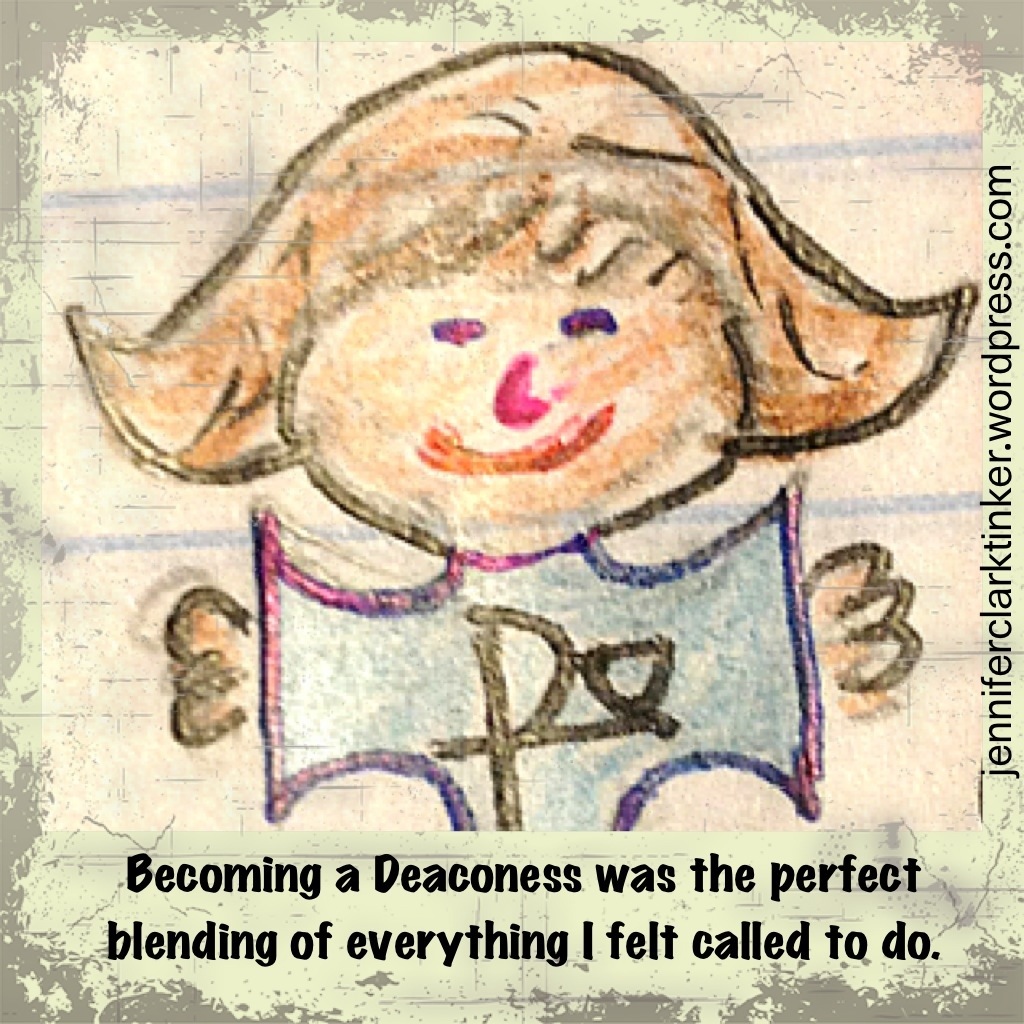
Becoming a Deaconess was the perfect blending of everything I felt called to do:

  • Serving God in and through the church,
  • Making a difference even beyond the local congregation,
  • Studying and teaching theology and God’s Word,
  • Not being required to be a pastor to do the above!

There were some logistics involved with being able to enter the Deaconess program, but eventually I got in! Then I got my Lutheran theology major, did my required practical ministry experiences, and lived into the “sisterhood” of Deaconesses and Deaconess students around me.

Finally, on August 19, 2001, at our second church in Indiana, I was officially consecrated as a Lutheran Deaconess. Between the beautiful worship service, the hog roast, and the family and friends who came from out of state, it was a grand celebration. It was both the end of a long-awaited goal and the beginning of a whole new journey.

What about you? Have you ever had a vision for something you wanted to do but you didn’t see a way to do it? What obstacles have you overcome to do or be what you felt was meant for you?

Do I Don’t Know?

“Sweetie, where are my big orange-handled scissors?”

My son, absorbed in his latest movie obsession, absent-mindedly replied, “I don’t know.”

“You were the last one to use them. Do you remember where you left them?”

Again, “I don’t know.”

Did he really not know? How could he not know since he was the last one to use them? Did he even care that they were missing or that I needed them?

I never realized how irritating it is to hear, “I don’t know,” until my kid learned to say it a few years ago.

To be fair though, I have been guilty of it too.

“Mom, when are we going to go to the park?”

“I don’t know.”

I realize now that must’ve been annoying for him. Did I really not know? How could I not know when I was the mom? Did I even care how much it meant to him?

“I don’t know,” is all too often an answer of convenience. We can answer someone’s question without being bothered to engage the matter. We say, “I don’t know,” when we are busy or distracted. We often say it when we want the problem or even the person to just go away.

We may think we’re getting off easy when we just dismiss something with an, “I don’t know,” but it hurts when the implication is “I don’t care.”

I know this, I don’t want anyone in my life to think I don’t care. That’s why I’ve been trying to catch myself when I am tempted to say, “I don’t know.” I’ve been making a conscious effort to engage in the problem or question instead of dismiss it.

Instead of saying, “I don’t know,” now I say these types of things:

I bet the library would have a book about stinging insects.

I’ll look it up and let you know at next week’s Bible study.

Let’s ask Grandpa what kind of rock this is.

Have you checked under your bed?

The last place I remember seeing it was on the table when you were making stick puppets.

I need to give that some thought.

I have enjoyed varying my approach to things I don’t know, but changing what I say is not just about turning a phrase, it represents a shift in my attitude. I am not trying to brush people off or dismiss their concerns. I don’t want to irritate folks, I want to honor them. I want to show people that I care in how I respond.

Can I keep this up? I don’t know. I sure hope so because the people in my life are worth it.

What about you? Do you have patterns of talking about things that may be working against you in relationships? How do you show you care by how you listen and respond to the people in your life?