Getting a laugh or bringing a smile?

Smile2

Oftentimes my first reaction to something is a selfish, arrogant, self-centered thought. However, as an introvert, I am ordinarily able to choose to actually say something more gracious. (Introverts are known for thinking before they speak.)

So, one may reasonably question, what is the truest portrayal of who I am? Is it the self-important first reaction or is it the deliberately-chosen, kinder, gentler words actually spoken?

Whichever is the most true is debatable, but it is certain that my first reaction is the funniest. There need be no debate on that. I can easily get a laugh if I just blurt out the first thing that comes to mind.

And speaking of the first thing that comes to mind, it could be argued that my first reaction is the most true. Were I quicker to speak that first thought, there would be integrity between what I think and what I actually say.

Does it necessarily follow that who we really are is exclusively a matter of our first reaction? Can we not be what we first think and what we choose to say or do in response?

If we have the presence of mind to catch ourselves from saying that witty first thought just to get a laugh, is that not saying something about about us? About our character?

See how I work these questions out over at Life & Liberty in my post, How a Well-Chosen Response Can Bring a Smile.

Receiving Others as Gifts: Mutuality in Giving & Receiving

20140314-135655.jpg

This is the first post in my new series about “Receiving Others as Gifts.” For background to this series, please read the introduction from last week: Introducing a New Series on Receiving Others as Gifts. To see all of my blog posts related to this subject, check out the tag: Others as Gifts.

I love the Kenneth Bailey video on footwashing that I posted back in November. I love everything about that video really. But most especially meaningful to me was how he made the case for how radical footwashing is and then how he lifted out the verse about how we ought to wash one anothers’ feet!

Bailey talked about the power dynamics at play when service is rendered. The idea was that service as we are called to is often from a position of power–the one has something the other needs–the giver is the one with the power.

Bailey rightly points out the danger of using service as a power play.

The way to guard against the power dynamics getting out of hand , then, is to wash one anothers’ feet–for each one to take turns both giving service to and receiving service from one another.

When it comes to receiving others as gifts, I think this idea of mutual giving & receiving is really important. The temptation to always be the one giving is great in our busy world.

We don’t want someone else to be put out. And we certainly don’t want to feel like we owe someone for some service they’ve rendered!

No, we’d rather be the ones doing the giving, doing the serving, doing that thing that puts someone else in our debt. Oh, of course, we don’t expect them to repay us–but that only heightens the sense of indebtedness that the one served may feel.

The most profound act of service we can render is to receive service from another, to lay down our need to be large and in charge and to humble ourselves enough to allow another to be or do for us something that we cannot do or be on our own.

Admitting that we can’t be all things to all people is often scary. To own our limitations and our neediness is not comfortable or automatic. It is a deliberate choice to drop our sense of superiority, to drop our self-centeredness, and to allow someone else to be greater or more central to us than we’d like.

Another feature of that Bailey video mentioned above is he calls attention to the bond that is formed when service is given and received. The two parties are brought into closer relationship by the service given and received.

We can choose to decline the service offered to us–I mean, we may not always need what is offered at exactly the time and place it is being offered. But to decline the service of others is to distance ourselves from those offering it.

We may have our reasons to decline, but it is wise to be aware of the cost. If we continually deny others the opportunity to serve us we may find ourselves in total isolation.

We may end up so far removed from others as to have no meaningful, sustaining community on which to rely when we eventually realize that we need it.

Plus, if we allow ourselves to become isolated by refusing to be served, then we’ll have no one left who needs or relies on us! Our own best service will be useless if we have no one close enough to us to receive what we have to offer.

I’m convinced that we need each other in this life. We need the gifts and service of others and they need ours too. This mutual giving and receiving is part of God’s original intent for us and Jesus affirms it.

May we be blessed by and be a blessing to others through our serving one another.


Read all the posts in the Receiving Others as Gifts series:

So Far: My First Blogiversary

20140311-234459.jpg

~ ~ ~

I can’t believe that it has already been a year since I started blogging here at Living Faith! What’s even more astounding is how many folks have come along for the adventure!

I really didn’t know what I was getting myself into when I started my blog. I never could have guessed where it would bring me in one short year, but I’m sure glad I’m here!

At first when I seriously considered starting a blog it was for the sake of staying connected with people after they hear me speak. As a “freelance” speaker & preacher I meet people in various locations and I wanted a way to maintain a presence in people’s lives after the speaking events or worship services.

But once I started the blog, then it began to take on a life of its own and I’ve done relatively little speaking & preaching compared to what I had hoped. So the blog itself became an entry-point for connections.

And then there were more and more connections through the blog!

Even people from my small town, people from my own church began getting to know me more deeply on the blog before hearing much from me live and in person or up front from a pulpit.

And then the other opportunities started coming along, some highlights of which were joining the staff at Life & Liberty, and getting my first real writing contract! Then a bunch of preaching and speaking opportunities came all at once in December which was cool.

My depression–which kept me from writing for so long–has tried to hold me back even since I started this blog. It has been particularly bad since December. I am getting help though, so that’s a good thing. And I am not letting it stop me from writing!

The biggest way I am combatting the depression is by trying to get more and more clarity about what I want to do with the blog and with my writing in general. I figure if this blogging & writing stuff is taking off for me, I want to be crystal clear about my purpose in it all.

I am particularly excited about the new series about “Receiving Others as Gifts” that I announced last Friday. It is exactly the kind of thing I need to be about with my writing and fits beautifully with my life message. I hope you will follow that series each week and let me know how it resonates with you.

This is for keeps now people. I am really, really, really doing this writing thing, and I look forward to many more blogiversaries! Thanks for being with me in this!

Imagination, Reality, and Kindness in the Realm

kindness-heart

One of my earliest areas of interest as a writer was in writing short stories. I often used my study halls in high school to write fanciful stories about imaginary lands. I even had a science teacher who would let me read my stories to the class if she finished her lecture early.

One gem of a story idea was inspired by an odd panel in the family room of the house where I grew up. This one panel was 1/5 the width of all the others and it had a knot-hole toward the bottom.

I imagined a land of little people who lived inside the knot-hole of that panel. And the little people inside there had what I considered a utopian society.

My version of utopia? The little people all lived and worked in harmony and treated one another with kindness.

Brilliant right?

And what laws governed this utopia? None. None at all.

The people weren’t good and kind because laws told them to be, they were good and kind because they wanted to be.

I never quite got around to writing the knot-hole people’s story because somehow this was not like my other stories. It was more of a vision. And it felt too big and too important to reduce to a short story.

But this utopian vision has stayed with me ever since then…

Click the heart in the photo above read the rest of this essay at Life & Liberty and find out what that youthful vision still means to me today.

My Review of Mediating Faith by Clint Schnekloth

Jen&Clint

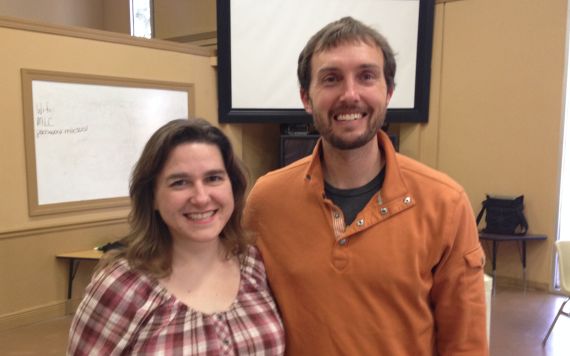
I got to see Clint Schnekloth, author of Mediating Faith, in person for the first time in Houston last Thursday when he came to talk about his book. He even let me interview him for the Life & Liberty podcast! Click the photo to go to Life & Liberty for our audio interview which is about 30 minutes.

Let it be stated for the record that I am friends with Clint Schnekloth, the author of Mediating Faith: Faith Formation in a Trans-Media Era, but I did buy my own copy of the book. I originally met Schnekloth on Facebook when I joined the ELCA (Evangelical Lutheran Church in America) Clergy Facebook group upon the recommendation of my local bishop, Michael Rinehart. Schnekloth has been a big help to me in my writing in several ways and it is my honor to help get the word out about his new book.

MediatingFaith

Click the book cover for ordering information.

The first thing I need to let you know about Mediating Faith is that if you think this is just a book about how particular types of media can be tools for ministry, you’re thinking too small. This book is way more than that. In fact, Schnekloth suggests that “all of life is mediated, and much more is media than we are often aware.”

To be frank, that suggestion both frightens and intrigues me all at once. I mean, I want so much to be “real” with people, to be honest in my writing, to have an authentic voice. To consider that everything I do is “mediated” made me squirm a little. But Schnekloth points out in a footnote that even the Bible itself is media–we are just so used to it that we forget to think of it as such.

It is just this kind of revelation about how media is integrated into our lives such that we forget it is even there to which Schnekloth invites us. Furthermore, if media is so integral to who we are, how best can we as people of faith be stewards of the wide range of media available to us to help pass on the faith?

And speaking of the wide range of media available to us, Schnekloth truly covers the spectrum from faith-formation practices based on historic texts to the mysterious world of massively multi-player online role-playing games (MMORPGs).

Once again, I admit I felt frightened at the mention of MMORPGs because this is a world that I don’t understand and have been reluctant to enter. So, imagine my surprise then when the part of the book that most delighted me came in insights derived from gaming!

After reading Mediating Faith, I am able to recognize my discomfort with MMORPGs is rather similar to the way I once was and many people I know still are reticent about joining Facebook. Whereas now, my Facebook, my own Facebook, my own most precious Facebook has become very much an extension of who I am. I mean, after all I met Schnekloth on Facebook!

The final thing I want to let you know about Mediating Faith is that you will want to have your dictionary.com handy while you’re reading, and maybe even Wikipedia. Schnekloth is not ascared of big words, but I promise you that every one he uses is worth looking up to get his full meaning.

I do recommend this book to those interested in stewarding the range of media available for the purposes of faith-formation. It is dense, but rich and worth your time. And I look forward to future works from Schnekloth and however else he finds to frighten me because just when his writing gets scary is when it gets really good.

P.S. Don’t forget to click the photo above to listen to our interview at Life & Liberty!