Posts Tagged ‘health’

How The Internet is Almost as Funny as God

20131213-232729.jpg

Who knew the Internet and God had this one thing in common–a be-careful-what-you-wish-for sense of humor?

God recently showed his sense of humor when he answered my prayer for more preaching opportunities.

In my current setting I don’t have a formal, ongoing, paid position in my church. Instead, I use my Deaconess training* here and there with a mix of paid and volunteer tasks in my own church and in other churches around my area.

Some of my most favorite work–times I feel most alive–are the times when I get to preach or speak. I’m still working on developing a formal speaking ministry. But the preaching opportunities are easier to come by when neighboring pastors need back-up, so I prayed for more of them.

It had been months since I preached last, but then, this fall, my church invited me to preach our Advent series. That would be 3 chances to preach and I was thrilled! Then a neighboring pastor called me with an additional 3 dates this month for which he needed back-up.

Suddenly here was December with 6 chances to preach! I just had to laugh at God’s sense of humor in answering my prayer in such a big way!

In a similar way, the Internet showed its sense of humor when it challenged my fears about being relevant with my blog. Last week I wrote the post How Being “Relevant” Eludes Me (click the title to read that post) and I lamented to the Internet:

I have a ton of ideas about what I want to write about. But I just never know what’s going to resonate with people.

I watch my blog stats (the details that I can view as a blog administrator about how many visits there are to my blog and what posts are being viewed) more closely than I need to. And I fret when something I feel good about doesn’t get as many views as I wish it did. And I hope, in admitted vanity, that this blog will really take off.

I know all the right things I should be thinking about my blog–that if even one person is touched by my writing then I am doing good work here. And I am always, always glad to know when that one person is touched. Please keep writing comments and e-mails and Tweets and Facebook messages to let me know because, truly, that’s what keeps me going when one person at a time is indeed touched by my work.

But right or wrong, I want to reach more people. And sometimes I shake my fists at the Internet and ask, in all ignorance, “What’s it going to take?”

And the Internet seems not to answer.

And then I had this really crummy day when I almost didn’t write anything. Except I have been trying to write more often and I was determined to post on Monday or Tuesday. Monday was a migraine day and I truly could not write. So it was Tuesday or bust. And despite my depression knocking me down, the idea of skipping Tuesday was worse than the idea of cranking out something irrelevant.

And so, I wrote Eat, Sleep, Preach: A Deaconess in Depression (click the title to see that post) and that post got a lot of attention. In fact, it became my most viewed post ever! Wednesday was my all-time biggest day on the blog. Lots and lots of people reached out to me in one way or another to express empathy or appreciation for what I wrote. Thanks to all who supported me by reading, responding to, or sharing the post. I am deeply grateful.

And I had to laugh at the Internet’s way of giving me such a big day over a post that I almost didn’t write on a day when I just wanted to stay in bed.

See what I mean? God and the Internet are both hilarious!

* I was trained and consecrated by the Lutheran Deaconess Association (LDA), an independent Lutheran diaconate based in Valparaiso, Indiana. The LDA allows me to keep the title of Deaconess despite not having a formal call as they recognize a wide range of service as diaconal. For more about my journey of becoming a Deaconess, see my post How I Became a Deaconess (click the title to read that post).

Eat, Sleep, Preach: A Deaconess in Depression

My depression is knocking me down this week. The will to do anything is elusive. My sense of worth is shot.

It’s not rational it just is.

You can’t talk me out of it.

I can’t even talk me out of it.

I’ve had my ups and downs over time and I’ve been on a bit of an upswing lately–feeling good about my writing and podcasting and all that good stuff.

It was in an upswing that I decided to finally start writing for real. I was tired of letting my depression hold me back in life and tell me I wasn’t good enough and didn’t have enough to say. I told my depression to go straight to hell and I was going to do this thing.

But that damned depression is creeping up again.

I mean, there’s the normal-people self-doubt and comparison trap that I get into sometimes and those bring me down, but there’s always something or someone that helps snap me out of those.

But this week–I’ve just been a mess and there’s nothing that can snap me out of it. I’m just a tear-stained, frumpy-clothed mess.

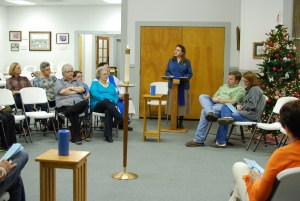
AdventPreaching2013And I hate this part of my story.

I much prefer the part of my story in which I’m the shiny-happy preaching Deaconess. (See photo.)

I’ve heard people criticize social media because of the way that people carefully curate their image–showing only their good sides, posting only the favorable photos, sharing only the triumphant moments.

To be sure, I want you to know about my highs! I want to tell you about my latest podcast that I’m proud of! I want you to see the action shot of me preaching.

But you deserve to know about today and the other days like it. About how I didn’t want to get out of bed. About how I stayed in my pajamas until I got the text that my husband was on his way home for lunch. And about how when my husband got home for lunch he cooked and loaded the dishwasher while I sat in a corner in the kitchen and wept and poured out my tale of woe.

I want to be honest about the whole of this life of mine. I’m the preaching Deaconess and the lady who doesn’t want to get up until after noon.

I know my depression isn’t the worst in the world. I did make it out of bed, so that’s something.

And the fact that I’m at this keyboard is because, as I told my journal today, if I can do nothing else, I will write about my damn depression. Because I’m doing this writing thing no matter what.

God knows there is so much more I want–and need–to write about. There’s so much to say I could burst sometimes.

I don’t want to write about my depression, but it is the elephant in the room right now and it takes too much energy to ignore it. It won’t let me think of anything else right now. So I’m writing about it. Because I’m doing this writing thing.

Photo by: Melissa Wickel

Weighty Matters: Learning from My Body

20131030-094814.jpg
I’ve been losing weight and people are noticing. I’d like to tell you how this came about and what I’m learning from my body.

I see this as related to living out my faith because God created this body of mine, so to ignore my body is to be at odds with my creator. And really, being at odds with God just never ends well for me.

Some Background

I really, really hate to talk about this, but I have what is called Irritable Bowel Syndrome (IBS). I hate talking about it because it is embarrassing to admit yet another way (besides my infertility problems) that my body doesn’t function properly, plus bathroom issues are just not a topic I enjoy–ever.

On top of that, IBS is a really frustrating diagnosis. Doctors don’t know what causes it, it’s not life-threatening, and there is no known “cure” for it.

There are ways of managing it, but they are often highly individualized solutions–the kinds that require a great deal of patient trial and error.

I have been in and out of doctor’s offices trying to get more answers. I wished for a long time for a different diagnosis–one for which the answers were more clear.

For quite a while I kept a food diary trying to figure out what foods made it better or worse. I could not find a pattern about specific foods, but in time I began to suspect that large meals exacerbated my symptoms.

Too Much to Handle

One might suppose that the solution was rather simple: if eating too much at once was a problem, then just eat smaller meals! While this sounds good in theory, it was harder in practice.

I did try to eat smaller meals, but I continued to have times when my symptoms would flare up and I was in a lot of pain. Still, the better I did at keeping my meals smaller, the better I felt.

I was actually doing pretty well until a few months ago when the pain got so bad that I ended up in the Emergency Room. It was pretty embarrassing for the only problem to have been my IBS.

New Discipline

After the embarrassing ER visit, I resolved to redouble my efforts to keep my meal size down. Putting less food on my plate was an obvious first place to start.

What I found though, was the most reliable guide for how much was too much was something even simpler still–to “listen” to my body. This was not something I learned as a kid in a family where the idea of “too much” of a good thing was laughable.

It has taken me a good deal of practice to actually key in to my body’s sense of fullness. And it comes surprisingly sooner than I would have guessed.

But in addition to the improvement in my IBS symptoms, listening to my body about my eating habits has also resulted in me losing some weight. I wasn’t looking for a weight-loss solution, but I’m glad that some good can come from this embarrassing condition.

Note: I am not a medical professional and my experience may not be typical. Please be sure to check with your doctor about your own weight and eating habits before making changes.

Hello Anxious My Old Friend

20130414-220533.jpg

I usually only have one commitment on Sunday mornings, but this Sunday I had three things for which I was responsible. I kept meaning to fit preparation for those Sunday commitments into my week, but the week went by with very little progress on my Sunday prep. When Saturday finally rolled around I was anxious all day about what I had to do on Sunday.

They say that anxiety is closely linked with depression. I have a history of depression, dating back to my teen years. I sunk to rock-bottom depression in my early days post-partum and at some point after having my son the anxiety kicked in. I have been on and off meds, and in and out of therapy. (I mentioned before that my history of infertility is the biggest reason why I don’t have more than one kid, but this depression/anxiety stuff factors in pretty prominently too.)

I’m better nowadays than I was even a couple of years ago, but I feel like I am still not back to my pre-baby self. The depression doesn’t surface as often as it used to and the anxiety, well some days are better than others. I can attest to the two being in cahoots because when the anxiety does kick in the depression buries me.

It works like this, I get stressed out about something I have going on. I am aware of what needs done, I may even make small efforts to do some of it. Still I don’t get done what I know I should because I am too anxious. Then I get depressed about not getting things done and I get really down on myself. The less I do, the more anxious I become. The more anxious I become, the less I do. This has the appearance of unforgivable laziness. I call this my shut-down mode.

So, that was my Saturday. I felt the weight of all that was coming for Sunday and I shut down for most of Saturday. Somehow, I managed to get everything prepped that I needed to do for my Sunday commitments and you know what, it wasn’t that much to do after all. And you know what else? My Sunday went fine, I would even say it went well.

That’s the thing about this anxiety stuff, it’s just not rational. There was really nothing to be anxious about! I learned early on in my anxious days that I need to pick and choose my commitments and focus on things that I do well. Everything I committed to today is stuff I do well. Not to mention the fact that our congregation is a loving, gracious lot by which I need not feel afraid or intimidated.

I sometimes think about getting back on meds or getting back to therapy, but when I think about that I get really anxious…

How I Cope with Infertility

20130326-205801.jpgI wrote the other day about my own struggles with infertility, and I wanted to share a little more about what has helped me cope with it. Here are five of the resources and types of interactions that have made a difference for me.

1. When I was trying to have a baby, I relied heavily on The Unofficial Guide to Overcoming Infertility.

I casually mentioned this guide by Joan Liebmann-Smith, Ph.D. in my previous post. The truth is I relied on this book heavily before my husband and I conceived our son. The majority of the book details causes of infertility and the types of treatments that are available. The extensive medical information helped me know what to expect at appointments and how to interpret results as we went along.

In addition to the medical information there were some key insights in the guide that helped me frame what I was dealing with and how to proceed:

  • The book addresses the reality that both men & women can have infertility problems. It goes on to recommend that both partners be screened for possibile fertility concerns. (This is common practice in reproductive medicine, but I learned it first from the guide.)
  • As the title of the guide mentions overcoming infertility, the author addresses this by suggesting there is more than one way to “overcome” infertility: overcoming could mean having a child, adopting a child, making the choice not to have children.
  • The author also warns of the strain that infertility can cause for a couple. Practical advice we found helpful was to talk with your partner about your goals and decide together how far you will go with treatment, when or whether to go the adoption route, and when you will walk away. Talking about these things was essential for preserving our marriage.

2. I realize that I am not the only one dealing with this when I get to talk with others with infertility concerns.

Many people find strength to face difficulties by talking with other people who are going through something similar. This was an essential aspect of my coping with infertility.

Nobody understood how painful a baby shower was for me as well as other women facing infertility. Others who had been in treatment longer than me could give me first-hand insight into what to expect. It was a great relief to know that we were not the only couple having trouble keeping the love in scheduled love-making.

I have found these relationships pretty naturally, but if you don’t know anyone else facing infertility you could look for a support group. You could check with your doctor, a local hospital, or a nearby counseling center to see if they know of support groups in your area.

You can also find information and support online:

  • Hannah’s Prayer Ministries provides Christian-based support and encouragement to married women around the world who are struggling with the pain of fertility challenges, including primary and secondary infertility, pregnancy loss, early infant death, and adoption loss. Our outreach extends to those who become mothers of living children through pregnancy, adoption, and/or foster care.
  • Hannah’s Prayer Community Forums is the message/bulletin board branch of Hannah’s Prayer Ministries. To join, you will need to register and agree to their statement of faith. Administrator’s approval is required and could take 1-2 days.
  • Resolve: The National Infertility Association, is a non-profit organization with the only established, nationwide network mandated to promote reproductive health and to ensure equal access to all family building options for men and women experiencing infertility or other reproductive disorders.

3. I draw strength from talking about my infertility struggles with caring friends and family who are not dealing with infertility challenges.

While nobody understands in the same way as someone else going through infertility, there are lot of caring people out there. Being appropriately open with people about my struggles has provided me with broad-based support. This can be risky which is why I usually start with sharing just the basics.

The types of people I talk with most about it:

  • wait for me to broach the subject of children,
  • let me talk as much (or as little) as I want to about my infertility,
  • listen with love,
  • accept me and my emotions (even my anger!) and do not judge me,
  • pray for &/or with me,
  • follow up with me after I share with them.

The types of people that make me uncomfortable:

  • don’t know me very well, but pry into why our family isn’t bigger,
  • make predictions and promises about my condition,
  • despite lack of experience, have a lot of unsolicited advice,
  • ignore my verbal &/or nonverbal cues that I don’t want to talk about it.

Specific things not to say are listed in How to Encourage Your Infertile or Bereaved Friends, the last article listed under The Issues on the Hannah’s Prayer website.

For general insight into caring for others in difficult times, you can read Don’t Sing Songs to a Heavy Heart: How to Relate to Those Who Are Suffering and/or Christian Caregiving: A Way of Life. Both books are by Dr. Kenneth C. Haugk, the founder of Stephen Ministries St. Louis.

4. I feel confident about my medical care when I have doctors who really listen.

Throughout my saga with infertility one of my biggest concerns has been my overall health. My particular infertility condition is a complex syndrome with additional implications for my health. Even when we were actively seeking pregnancy I didn’t want to ignore my overall health and just get a baby at any cost. Then and now I am most confident about the care I am getting when I feel like the doctor really listens to my concerns and goals for treatment.

Finding a doctor like that can be easier said than done. I wish I had better recommendations for a sure-fire way to find a great doctor. Many people are limited by geography or insurance issues. Still, if you have a choice, don’t be afraid to get a second opinion or to find a doctor that is a better match for you.

Word of mouth is a great way to find a good doctor, which goes back to #2 above. Perhaps some of the links in that section could help you connect with people in your area who can make good recommendations.

5. Even when I’m mad at God, I need the support of my faith communities.

It was a big turning point for me before we had our son when I finally asked to be added to the church prayer list for my infertility concerns. I had told one or two people in the church, but most people had no idea. When I asked for prayer it became public. I was nervous at first, but my church family at the time held my prayer need with utmost respect.

When I am struggling in my faith I am particularly glad for corporate worship and liturgy in particular. Even if I can’t pray, the community of faith carries me through their prayers. Churches who do liturgical worship are accused sometimes of “just going through the motions.” I have to tell you though, when infertility plunged me to my lowest point, those “motions” were all I had. Reciting liturgy that I have memorized, that I know by heart allowed me to pray when I would not have otherwise been able to pray.

One thing that helped me also was when my congregation and other supportive faith communities became aware of the pain of infertility. Due to awareness about infertility, my church family prayed for couples who cannot have children on Mother’s Day and Father’s Day. Before I had my son, fellow members of an online discussion group for Pastor’s Wives made a point to show sensitivity when sharing about baby news.

These are the things that have helped me. What has made a difference for you in facing infertility? What other resources do you know of that can help raise awareness about infertility?