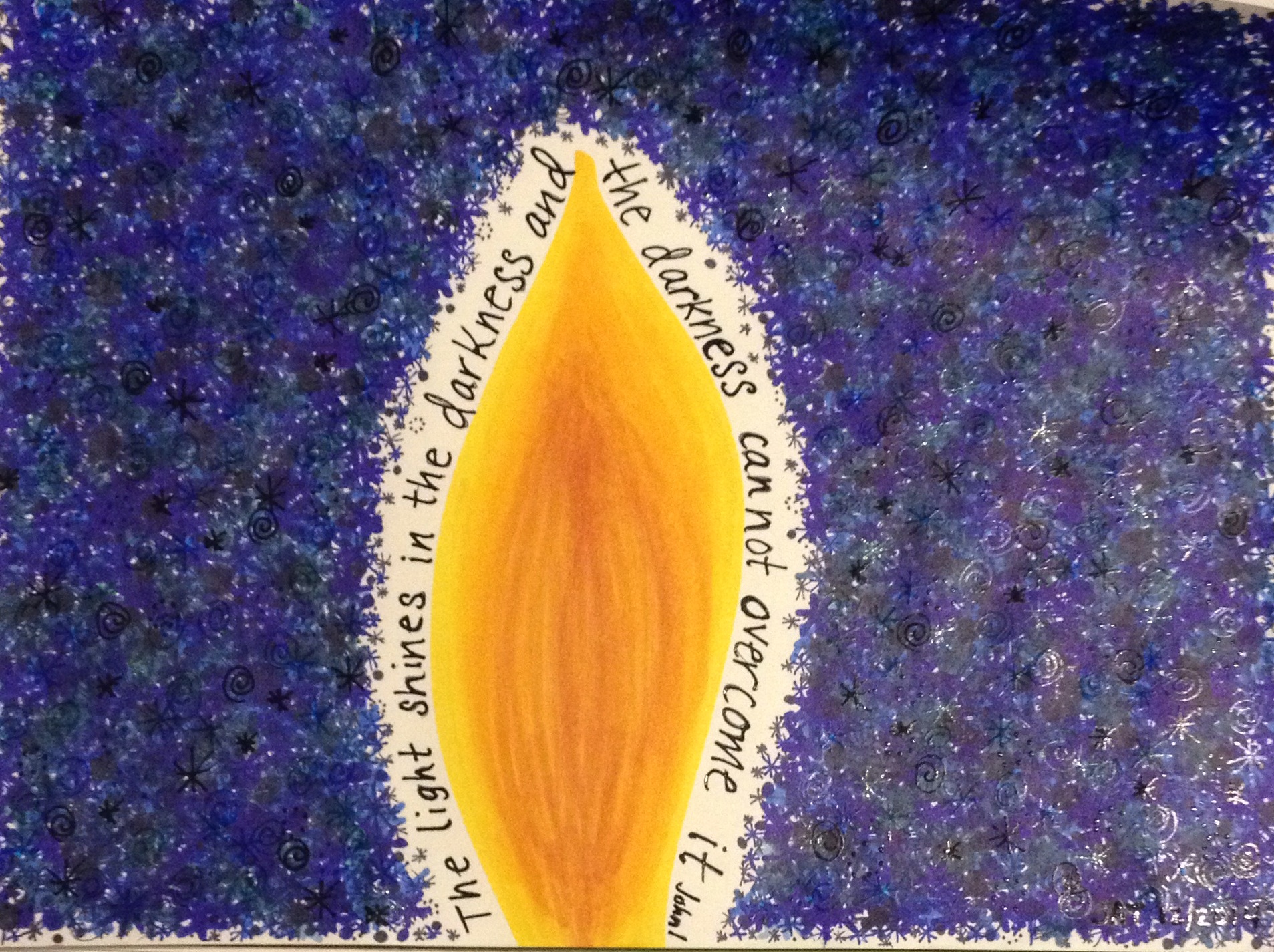
2015 New Year’s Resolution

IMG_4277

Artwork by Jennifer Clark Tinker

Well, it’s still January, so I hope it’s not too late to wish you a Happy New Year!

It has taken me this long to get around to doing something about a “New Year’s Resolution.”

I am not normally a New Year’s Resolution person. Last year I did a word for the year. My word was “present” and I came up with three resolutions to go along with that word.

The truth is the word mattered more than the resolutions. I don’t even remember what all three of them were, just that there were three. The only one I remember is one I totally failed at.

That’s pretty much been my experience with resolutions.

2015 was almost going to be the year where I decided not to bother with resolutions.

And then my old buddy David Housholder posted something really lovely about the value of setting your intentions for the year. And when David Housholder is right, he is right.

Then I sat around and felt guilty about not having a resolution. And I’m sure that’s not how it’s supposed to feel in a year where you deliberately choose not to have a resolution.

So, once again I toyed with the idea of resolving not to make any resolutions this year. I mean, when you call it a resolution to not make a resolution, then you’ve got your bases covered, right?

Then…well, then I had a breakthrough…

See, in addition to my writing and speaking, I’ve always been a bit artsy-crafty. I gravitate primarily to crochet and paper crafts–especially those involving gel pens.

Over the past few years I’ve been working on cultivating my skills in doodling and hand-lettering. You may have noticed the art with my post titled Christmas Glow–the image of light shining in the darkness? Well, I doodled that.

Since I have this job now as the interim minister at a nearby church, I am preaching every week. And I am using a lot of words writing sermons. So, not a lot of writing is getting done here or otherwise.

But as I prepare for each sermon, after I do the majority of my study, I let the scriptures for the week bounce around in my subconscious for a while. Some words and images from the scriptures often pop into my conscious thoughts, and I have found it very meaningful–and fun–to create “scripture doodles” for them.

Meanwhile, I joined a spiritual reflection group that encourages “art journaling” as part of the process. And I got a new book, “The Art of Whimsical Lettering,” by Joanne Sharpe, for my birthday.

Soooo…I’ve been doodling and lettering like crazy. And I’m loving it. And I’m finding that the more I create, the more creative I feel. It centers and relaxes me, and it also refreshes and energizes me. It’s really quite wonderful.

And not to be boastful, but I think my doodling is getting better and better all the time. My son even remarked to me the other day, “I’m beginning to think your doodling is more than just ‘doodling.'”

It actually got to the point that I was a little worried that I might have been spending too much time with my doodling. But every time I mention it to my husband, he encourages me exuberantly–I think partly because he knows how much joy it gives me and also because he seems to enjoy what I create with it.

If it helps my creativity, gives me joy, and delights others, then I think these doodling “jenanigans” are worth pursuing. My son is most insightful, my doodling is more than just “doodling”!

And so, that leads me to my one and only official New Year’s Resolution for 2015:

Doodle more often and call it art.

Christmas Glow

Light in Darkness

The light shines in the darkness and the darkness cannot overcome it. John 1


Light has always been an important symbol of Christmas for me.

In 8th grade I wrote a short story about a teenage young woman who was having trouble getting into the “Christmas spirit.” No matter what she did, she couldn’t work up the giddiness she used to feel about the season.

Then in church on Christmas Eve, during the candle lighting ceremony, she had an epiphany. The warm glow of the lights around the darkened sanctuary reminded her of the Good News of Jesus coming into the world to bring the light of God’s love to all people.

The story was a fictional representation of what was in my own heart–and often still is. I don’t get giddy about Christmas anymore like I did when I was a little kid. A lot of the “magic” of Christmas has faded in its importance and impressiveness in my heart and mind.

But this news–that God brings light to our darkness–I need that every-always.

If I’m going to feel anything special at Christmas, it’s almost certain it will involve light (or gel pens, but that’s kind-of the same thing).

During Christmas break in 1994, while I was engaged to my now husband, I got to go as his date to his brother’s wedding in Florida. I was in college in Kentucky at the time and went home to Ohio for Christmas and had my wisdom teeth pulled right after Christmas. I was miserable, but didn’t want to miss the wedding–the first wedding among my now husband and his siblings!

My now sister-in-law Angela was from the area where the wedding was, so she had insider knowledge on local attractions. One of the nights we were there Angela wanted to take us all to a Christmas village of some kind. I didn’t know what to expect and my mouth was sore, and I was weary from travel, so I wasn’t even sure if I wanted to go.

But I am so glad I did!

The Christmas village was this whole lot filled with sweetly painted wooden-facade little houses and buildings. All of the little structures were decorated in lights. You could go up and down the “streets” of this village and see all of the places lit up.

I don’t even remember if there was anything distinctively Christian about the display, but the light–Oh! All those lights! They lit up my heart that night and I will always remember the night Angela took us there.

To this day, even if I can’t manufacture any “Christmas spirit,” I am filled with hope, awe, and wonder when I see peeps of light at Christmas in candle lighting ceremonies and light displays.

There’s something about light shining in darkness that speaks to my heart in a way that daylight or a brightly lit room doesn’t quite do.

I often think of my depression as darkness as worries close in on me, and my sense of worth dims. So, I understand darkness all too well. So when tiny lights defy the darkness, I am reminded that God–my God–is bigger than my darkness.

My favorite Psalm says it this way, “If I say, ‘Surely the darkness shall cover me, and the light around me become night,’ even the darkness is not dark to you; the night is as bright as the day, for darkness is as light to you.” (Psalm 139:11-12)

Even in my darkness, my God sees me and knows me and loves me.

Once again this Christmas, I can’t seem to manufacture that giddy Christmas feeling of my childhood. But the glow of God’s love fills me with hope at Christmas time–and always.

May you too know God’s love with a tenacious hope that defies darkness.

Look Who’s Stooping

Sometimes we’re asked to do something that we don’t feel worthy or prepared to do. How does the life and ministry of Jesus affect our sense of worth?

This sermon based on Mark 1:1-8 explores this idea. This was originally preached and recorded on the 2nd Sunday of Advent, December 7, 2014 at Emmanuel Lutheran Church in Greenvine, TX.

Click the following link to listen to the message or scroll down to read the manuscript:

http://www.spreaker.com/user/5989422/look-whos-stooping


Look Who’s Stooping

A missed call showed up on my cell phone a few weeks ago. When I saw that it was from Pastor Blair Lundborg from the synod office, I said to my sister-in-law, Karen, “If this is about a job, the answer is ‘yes.’

“Don’t you want to find out what the job is first?” Karen challenged me.

“Well, of course I’ll hear him out before I say ‘yes.’ But I think this is an answer to prayer. I have hoped to find a way to be of service in our synod, and if my synod is calling me about a job, then this might just be what I’ve been waiting for. So, I’m pretty sure it’s a ‘yes.'”

When I got a free moment I returned Pastor Lundborg’s call. It was, in fact, about a job, but to be completely honest with you, when he told me what he had in mind, I was a bit nervous. He invited me to serve as the interim for Emmanuel in Greenvine. This job was a step beyond what I had imagined for myself.

For one thing, an interim assignment—even one at half-time—would mean a great deal more hours than I had worked at a paying job in a very long time. But also, it is a job that is ordinarily filled by an ordained pastor, which I am not.

I found myself rethinking my words to Karen about being able to say, ‘Yes’ on the spot. I did indicate interest, but wanted some time to think it over.

I had to ask, ‘Am I prepared for this ministry?’

After some thought and prayer and conversation with my husband, I realized that, with the help of God, I could do this. So I told Pastor Lundborg I wanted to move forward with the possibility. He got me in touch with y’all and we agreed on a contract for me to come be your interim minister.

The feeling I had about wondering if I was prepared for this assignment, is similar to what John the Baptist experienced. Despite being the one to prepare the way for Jesus’ ministry, John the Baptist wrestled with his own anxieties about the situation.

John the Baptist had crowds coming to him from the big city and from across the countryside. They were eager to hear his message and receive the baptism he offered.

But John knew that his work was not for his own sake. He was there to point to Jesus.

John himself recognized that Jesus’ ministry was more important than John’s and that Jesus would surpass him. In Mark 1:7-8, John says of Jesus, “The one who is more powerful than I is coming after me; I am not worthy to stoop down and untie the thong of his sandals.”

Now, I don’t know about you, but when I think of John the Baptist, I imagine him as a rather primitive character. He wore clothes made of camel hair and he ate locusts and wild honey. So, when John talks about feeling “not worthy to stoop down and untie the thong of Jesus’ sandals,” I can begin to imagine why.

Yet, as I already noted, he did have crowds coming to him, so he obviously had a good thing going. Still, he had that sense of feeling unworthy compared to Jesus.

Goodness. I can certainly related to feeling unworthy as compared with Jesus. I was even nervous about becoming an interim minister, but John was the opening act for Jesus!

“Not worthy to stoop down and untie the thong of his sandals.”

It’s not clear from this text whether John the Baptist knew the identity of the one coming after him.

Did he know that it was his cousin, Jesus? If you’ll recall from the story from the Gospel of Luke, John the Baptist was 6 months older than Jesus; their mothers were pregnant around the same time.

I have a lot of cousins, some older and some younger. The older ones will always be people I am in awe of. And the younger cousins will always be people who I knew as babies.

When you think about it, it almost seems strange for John not to feel worthy compared to his baby cousin.
But see, that’s just how disarming Jesus’ story is.

John didn’t feel worthy to stoop down and untie Jesus’ sandals, and yet God himself stooped to become one of us in the person of Jesus Christ.

And this is the wonder that we behold as we prepare for Jesus birthday at Christmas. Jesus stooped to be born as one of us, to be a baby—even a baby cousin! He stooped to live out life among us—and one of us.

It is worth noting that the name of this church, Emmanuel, means “God with us” in honor of the reality of God stooping to be one of us.

And Jesus stooped lowest of all, enduring the humiliation of a death sentence.

God in Christ Jesus came to be one of us to demonstrate once and for all that we don’t have to do anything to become worthy. Humanity is so loved by God, that God came to be one of us—to live and die and rise again for our sakes.

And through Jesus’ rising from the dead, Jesus proves once and for all that we have nothing left to fear—not even death and the grave. And that with God’s help, we can do more than we thought possible.

So, being an interim minister is new for me. And, this particular pastoral transition is new for you as a congregation. While you’ve had pastors come and go in the past, each pastor is different. There is no one quite like Pastor Rich. And having your lives touched by him has changed you—and from what I can tell, it has changed you for the better. Now that he is no longer pastor here, you too may have your anxieties about your future as a congregation.

Or maybe there are other challenges you’re facing in your daily lives? Perhaps you have a new job, a new school, new friends, or new stage of parenting. Whatever it is, we are often faced with experiences that push us to do more than we feel prepared to do.

Oh, sometimes we might need more training or study to be able to do what is asked of us. And it’s a good idea to take advantage of opportunities to learn and grow in our skills. But let’s not overlook the ways that God can and does work through us right now.

We can entrust our ministry together, our jobs, our classes, our friendships, and our families to our Lord. We don’t have to be anything other than who we are to be dearly loved by the God of the universe. We don’t have to feel unworthy of service in the church and in the world, because we look to and trust the God who stooped for us, empowering us to love and serve in his name.

For Us

Once after a speaking engagement, someone asked me if sharing hard stories helps me. I was puzzled because I ordinarily share because I want to help others know they’re not alone in the hard times.

As one who has a public dimension of speaking and writing it is an interesting question. I know that it does help me to think out loud or on paper about the hard times–but these are very private processes, usually involving tears, many, many tears. The outpouring itself is cathartic.

The public sharing though, that brings its own kind of difficulty. The choice to make the private thoughts public has to bear up under scrutiny: Does this even make sense? Does it really have the chance to help someone else? Does it make me look bad, and if so, how bad? And if it makes me look bad, what might be the costs of looking bad in that way?

After all that, then I weigh the question, am I looking for sympathy? And usually the answer involves a recognition of what a wise Deaconess once said, “There is no such thing as a truly pure motive.”

I would love to be able to stand behind my original sentiment–that I share to help others. Yet I know my altruism isn’t pure. And I wouldn’t do this public bearing of my soul if it didn’t come with at least some kind of benefit to me.

Even now I am aware of the way in which sharing here about my aimless aching just a couple of days ago has given me strength to move through this weekend. It didn’t make the ache go away–that would be far too much to ask. But pouring out the thoughts was the catharsis I so appreciate about writing. And sharing here has helped me because of the feedback from readers who have told me that I am not alone in the aching.

Does sharing help me? I have to say, yes. Does it help others? It seems to. What I’m realizing is that it doesn’t have to be one or the other. It can be both. I hope it is both.

I think what I hope most of all is to deepen community–for you, and for me, for us together–as we share, honestly share, the hard times.

Aimless Aching

IMG_4215

I can’t even sort out what I’m feeling or thinking right now. I don’t even know if I can sort the feeling from the thinking.

Mostly I ache. And the ache cuts through my gut. I want to vomit to get that ache out of me, but I can’t.

I want to cry again and again. Except when the tears roll, I feel the ache roll, wet, down my cheeks. I want the tears to wash the ache away, but after the tears are gone the ache lingers in my face, hot from crying.

I try to use my words to talk out the ache, but they jumble and ramble and go in circles. And I want to get my thoughts around the ache, but the ache mocks my thinking–even my best thinking.

And I can’t tell anymore if I’m choking back the ache or if the ache is choking me.

I don’t even know why I ache so hard. Mostly I’m selfish with my aching–making the pain of the world about me–about the pain that I don’t understand well enough, listen to enough, or address squarely enough.

What right have I to ache when there is pain far worse than mine? So I chastise myself for my selfishness–heaping shame upon the ache which only makes it grow.

The worst ache is when I see people create more aching with hate. I try hard not to trade hate for hate. But the hate is too much for me to process. All I know to do in the midst of the hate is to ache. I ache with the hated and I ache for the hater. I ache for the brokenness and the ache upon hate upon ache upon hate.

I want to do something–to turn the ache into action. The ache is fuel, burning up, but with no engine it is wasted. It is an endlessly renewable source of energy–because there’s always something to ache about–but the energy is wasted without a place to go.

But where am I to go? What am I to do with this hot-burning fuel?

I think words will help. Words should help. I know words. I want to help with my words. I want to use my words to do good. But all I can do today is explain the ache. But what good are even the best words about the ache when so much pain is in the world?

I want to think this aimless aching is just a phase. I hope–I pray–for a time to know better my purpose, my place, my way to use this ache–to aim this passionate-hot ache to sow love so deeply that hate will fade, fail, and fall away.