Archive for the ‘Community’ Category

Is it Really Good Enough?

Yesterday my friend Sarah Bessey shared a link to a guest post by Tara Livesay over at D.L. Mayfield’s blog. In the post Tara Livesay talks about her life in Haiti and her concern about visitors who come for mission trips.

Tara laments the tendency of visitors to view themselves as the heroes and to look at the people of Haiti as “projects.” She writes about the air of superiority and even the disdain with which some visitors view the people of Haiti.

Tara says,

It is not at all unusual to hear visitors botch something up they are working on and say, “Oh well, it is good enough for Haiti.”

That post hit me right between the eyes, because I was one of those visitors. When I was 17 years old (over half my lifetime ago), I went on a week-long mission trip to Haiti.

I know I went there thinking I was going to be a hero. The real truth of that trip is that the people of Haiti made more of an impact on me than I did on them.

When it came down to it, I avoided the hardest work projects because they were too hard. Even when I did help out with doable things, I remember just feeling hot all the time.

My half-baked efforts were far from “good enough for Haiti.” The “project” was too much for me. I failed it.

The only good I did in Haiti was when I joined in their singing. I was terrible at it because I was unsure of the words, their meaning and their pronunciation.

20130405-160409.jpgWhen we gathered with Hatian churches or Haitian school children, there was so much singing. Their singing was so joyful, so exuberant. They knew the words even if I didn’t.

I eeked out the words the best I could manage. And the best thing about singing with them was that it was with them. It wasn’t something I did for them because I was better. It was something we did together.

I still remember some of those songs and I still sing them from time to time. It is part of the lasting impact that the people of Haiti have had on me.

Still, I think part of me has carried a sense of failure that I didn’t make the impact on Haiti that I intended.

My son was in public school when Haiti had been devastated by the earthquake. So I dusted off my photo album from Haiti, made a slide show and spoke to my son’s class. I wanted to do something helpful, to Raise Awareness.

Now though, after reading Tara Livesay’s post I wonder if my little talk only perpetuated the “we as heroes” narrative. Did I use that opportunity to make up for my failure at the “project” earlier in my life?

I started writing this post last night before I went to bed and I have been mulling it over all day. I want to be able to wrap it up in some meaningful conclusion. I can’t seem to do it though because Tara’s post has left me with more questions than answers.

Could it be that is a good thing?

The Teacher Who Showed Us Jesus and Gave Us a Conscience

20130401-183713.jpg

Welcome to “Tuesday Tributes,” a new series here on the blog. The series is about lifting up people who have impacted our lives. They may be our teachers, neighbors, parents, friends, or mentors.

Each Tuesday I will share a story about someone who has inspired me, mentored me in the faith, or shaped my character. Then you can tell your stories in the comments about someone who has impacted you in a similar way.

Today’s tribute is about Mrs. Bricker who was my 5th grade teacher.

How do public school teachers manage to remain faithful to Christ when they are not supposed to invoke his name in the classroom? If Christians are to be light to the world, how much are public school teachers allowed to shine before administration tells them to hide it under a bushel?

I don’t know if Mrs. Bricker ever told us she was a Christian that year, but when I found that out it was not a surprise to me. She probably wasn’t supposed to talk about such things, but even without talking about Jesus, she showed us his love.

Mrs. Bricker worked with us to write our own class rules. She encouraged us to think out-loud together about the importance of respecting one another.

She modeled respect in how she treated each one of us. She never raised her voice. She didn’t have to because we respected her.

When we misbehaved for other teachers, Mrs. Bricker corrected us calmly. She was clear that we had messed up, but her kindness gave us hope that we could do better.

Toward the end of the year Mrs. Bricker taught us a poem that she memorized in school. It was called, “Myself” and the author wrote about wanting to make choices that he could live with. Mrs. Bricker told us that these words had always stuck with her and made her think of the choices she made in life.

Each of us was required to recite the poem aloud to the class. We didn’t have to memorize it but I have always remembered the lessons she taught us with it.

The last couple of lines always stuck with me,

Whatever happens I want to be

Self respecting and conscience free.

I felt inspired by this idea of behaving in ways that would leave me with a clean conscience. The poem resonated with me all the more because Mrs. Bricker showed us what it looked like to live that way.

Like I say, Mrs. Bricker didn’t cross any lines separating church and state. She simply showed us Jesus by respecting us, and teaching us to respect one another. I believe she was Jesus to us when she gave us dignity even when we did undignified things. Through modeling “conscience free” living, she was pointing us to God’s better way for our lives.

When I speak to groups about living out their faith in their everyday lives, inevitably someone raises the question of “what if my job won’t let me talk about Jesus?” I think of people in my life like Mrs. Bricker and I tell them you do it by showing them the love of Jesus through your love and respect for them.

What about you? Do you recall teachers who both gave and received respect in the classroom? Who has helped shape your character or conscience? Who in your life has shown you the love of Jesus in how they have treated you?

How I Cope with Infertility

20130326-205801.jpgI wrote the other day about my own struggles with infertility, and I wanted to share a little more about what has helped me cope with it. Here are five of the resources and types of interactions that have made a difference for me.

1. When I was trying to have a baby, I relied heavily on The Unofficial Guide to Overcoming Infertility.

I casually mentioned this guide by Joan Liebmann-Smith, Ph.D. in my previous post. The truth is I relied on this book heavily before my husband and I conceived our son. The majority of the book details causes of infertility and the types of treatments that are available. The extensive medical information helped me know what to expect at appointments and how to interpret results as we went along.

In addition to the medical information there were some key insights in the guide that helped me frame what I was dealing with and how to proceed:

  • The book addresses the reality that both men & women can have infertility problems. It goes on to recommend that both partners be screened for possibile fertility concerns. (This is common practice in reproductive medicine, but I learned it first from the guide.)
  • As the title of the guide mentions overcoming infertility, the author addresses this by suggesting there is more than one way to “overcome” infertility: overcoming could mean having a child, adopting a child, making the choice not to have children.
  • The author also warns of the strain that infertility can cause for a couple. Practical advice we found helpful was to talk with your partner about your goals and decide together how far you will go with treatment, when or whether to go the adoption route, and when you will walk away. Talking about these things was essential for preserving our marriage.

2. I realize that I am not the only one dealing with this when I get to talk with others with infertility concerns.

Many people find strength to face difficulties by talking with other people who are going through something similar. This was an essential aspect of my coping with infertility.

Nobody understood how painful a baby shower was for me as well as other women facing infertility. Others who had been in treatment longer than me could give me first-hand insight into what to expect. It was a great relief to know that we were not the only couple having trouble keeping the love in scheduled love-making.

I have found these relationships pretty naturally, but if you don’t know anyone else facing infertility you could look for a support group. You could check with your doctor, a local hospital, or a nearby counseling center to see if they know of support groups in your area.

You can also find information and support online:

  • Hannah’s Prayer Ministries provides Christian-based support and encouragement to married women around the world who are struggling with the pain of fertility challenges, including primary and secondary infertility, pregnancy loss, early infant death, and adoption loss. Our outreach extends to those who become mothers of living children through pregnancy, adoption, and/or foster care.
  • Hannah’s Prayer Community Forums is the message/bulletin board branch of Hannah’s Prayer Ministries. To join, you will need to register and agree to their statement of faith. Administrator’s approval is required and could take 1-2 days.
  • Resolve: The National Infertility Association, is a non-profit organization with the only established, nationwide network mandated to promote reproductive health and to ensure equal access to all family building options for men and women experiencing infertility or other reproductive disorders.

3. I draw strength from talking about my infertility struggles with caring friends and family who are not dealing with infertility challenges.

While nobody understands in the same way as someone else going through infertility, there are lot of caring people out there. Being appropriately open with people about my struggles has provided me with broad-based support. This can be risky which is why I usually start with sharing just the basics.

The types of people I talk with most about it:

  • wait for me to broach the subject of children,
  • let me talk as much (or as little) as I want to about my infertility,
  • listen with love,
  • accept me and my emotions (even my anger!) and do not judge me,
  • pray for &/or with me,
  • follow up with me after I share with them.

The types of people that make me uncomfortable:

  • don’t know me very well, but pry into why our family isn’t bigger,
  • make predictions and promises about my condition,
  • despite lack of experience, have a lot of unsolicited advice,
  • ignore my verbal &/or nonverbal cues that I don’t want to talk about it.

Specific things not to say are listed in How to Encourage Your Infertile or Bereaved Friends, the last article listed under The Issues on the Hannah’s Prayer website.

For general insight into caring for others in difficult times, you can read Don’t Sing Songs to a Heavy Heart: How to Relate to Those Who Are Suffering and/or Christian Caregiving: A Way of Life. Both books are by Dr. Kenneth C. Haugk, the founder of Stephen Ministries St. Louis.

4. I feel confident about my medical care when I have doctors who really listen.

Throughout my saga with infertility one of my biggest concerns has been my overall health. My particular infertility condition is a complex syndrome with additional implications for my health. Even when we were actively seeking pregnancy I didn’t want to ignore my overall health and just get a baby at any cost. Then and now I am most confident about the care I am getting when I feel like the doctor really listens to my concerns and goals for treatment.

Finding a doctor like that can be easier said than done. I wish I had better recommendations for a sure-fire way to find a great doctor. Many people are limited by geography or insurance issues. Still, if you have a choice, don’t be afraid to get a second opinion or to find a doctor that is a better match for you.

Word of mouth is a great way to find a good doctor, which goes back to #2 above. Perhaps some of the links in that section could help you connect with people in your area who can make good recommendations.

5. Even when I’m mad at God, I need the support of my faith communities.

It was a big turning point for me before we had our son when I finally asked to be added to the church prayer list for my infertility concerns. I had told one or two people in the church, but most people had no idea. When I asked for prayer it became public. I was nervous at first, but my church family at the time held my prayer need with utmost respect.

When I am struggling in my faith I am particularly glad for corporate worship and liturgy in particular. Even if I can’t pray, the community of faith carries me through their prayers. Churches who do liturgical worship are accused sometimes of “just going through the motions.” I have to tell you though, when infertility plunged me to my lowest point, those “motions” were all I had. Reciting liturgy that I have memorized, that I know by heart allowed me to pray when I would not have otherwise been able to pray.

One thing that helped me also was when my congregation and other supportive faith communities became aware of the pain of infertility. Due to awareness about infertility, my church family prayed for couples who cannot have children on Mother’s Day and Father’s Day. Before I had my son, fellow members of an online discussion group for Pastor’s Wives made a point to show sensitivity when sharing about baby news.

These are the things that have helped me. What has made a difference for you in facing infertility? What other resources do you know of that can help raise awareness about infertility?

How I Became a Deaconess

20130319-043432.jpgBeginning in my ‘tweens, once a month members of my Lutheran congregation on the hill would lovingly cook a big meal and drive from our little suburb to the big city of Columbus, Ohio. We served the patrons of Faith Mission, a homeless shelter in the inner city. The cooking part was fun, but I especially loved interacting with the patrons and seeing “the hungry” as real people.

During my Junior year of high school that same Lutheran congregation gave me the opportunity to teach a 3rd & 4th grade Sunday school class. I loved opening up God’s Word with them and talking together about it in ways that made it come alive. I particularly remember teaching about Noah and the big flood shortly after our suburb had some major flooding.

I cherished these experiences in my church growing up and as early as middle school, I knew I wanted to be in ministry somehow. I knew I was dearly loved by God and my church family and I wanted to spread that love to others. I wanted to be always a part of what God was doing in and through the church.

I felt called by the Holy Spirit into a life of ministry.

There was only one problem, the only ministry role I knew of was that of pastor. I didn’t want to be a pastor and I didn’t feel that was my calling exactly.

My vision was to study Lutheran theology and church-work on an undergraduate level. Then I would go serve in a congregation.

I wanted to partner with people to reach out beyond the church walls (like I had done at Faith Mission). I wanted to share God’s word with people in Bible classes and informal conversations, encouraging them in their faith.

When it came time to choose a college I looked for something like a theology major or a non-pastor, church-worker study program. The Lutheran colleges I looked at during that time had nothing of the sort.

I drifted for a while, starting college with no clear plan for a major or career path. After my first year of college in Kentucky, I married a pastor and moved to Indiana where he was pastoring his first church.

It was early in our marriage that I found out about the Deaconess program at Valparaiso University, a Lutheran university in Indiana.

In a pamphlet from the Lutheran Deaconess Association I learned that through:

  • theological study,
  • hands-on ministry experiences,
  • and being in community with other Deaconesses and Deaconess students,

I could become a trained church-worker!

The pamphlet also talked about a variety of settings (churches, social service agencies, hospitals, etc) in which a Deaconess could serve. I read that regardless of the setting, the common bond among Deaconesses is a “servant’s heart,” the willingness to love and serve others as Jesus loves and serves us.

The more I read about the Deaconess program, the more I knew this was a fit for me.

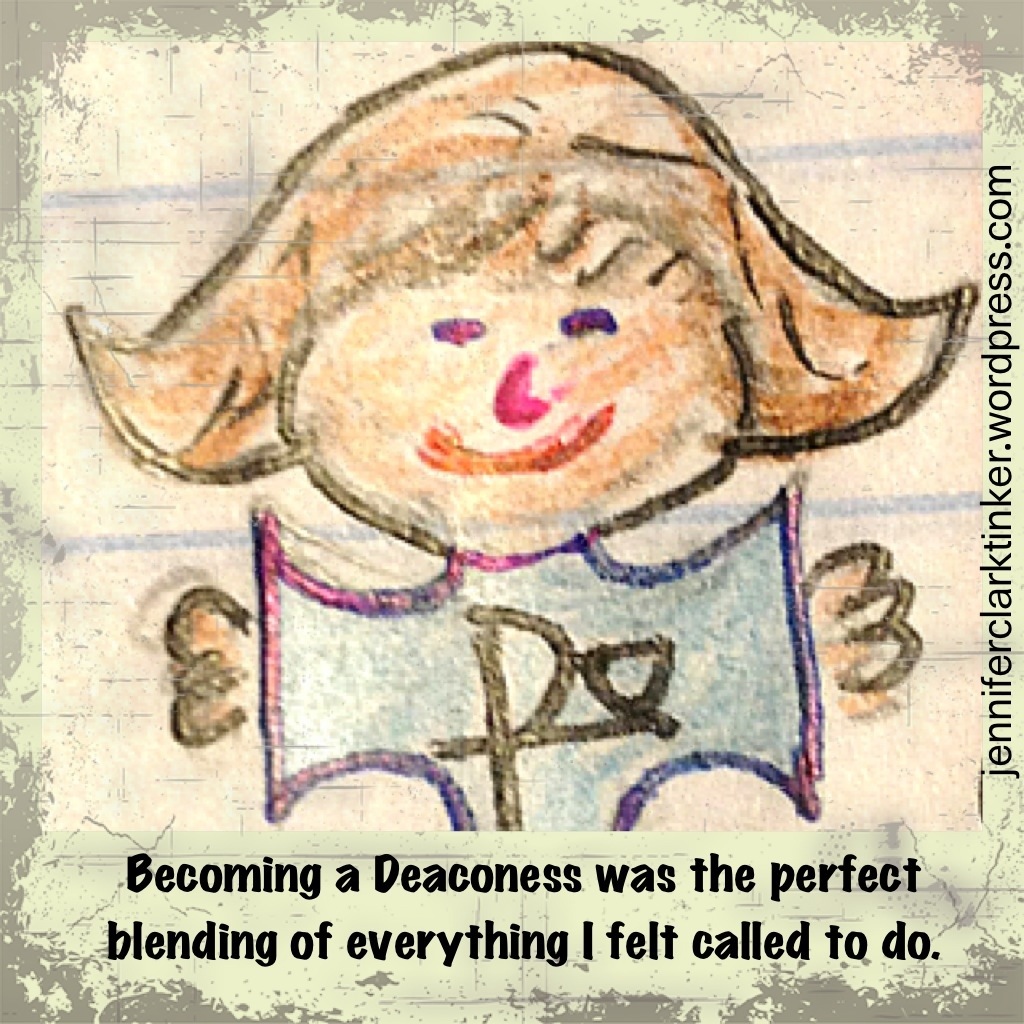
Becoming a Deaconess was the perfect blending of everything I felt called to do:

  • Serving God in and through the church,
  • Making a difference even beyond the local congregation,
  • Studying and teaching theology and God’s Word,
  • Not being required to be a pastor to do the above!

There were some logistics involved with being able to enter the Deaconess program, but eventually I got in! Then I got my Lutheran theology major, did my required practical ministry experiences, and lived into the “sisterhood” of Deaconesses and Deaconess students around me.

Finally, on August 19, 2001, at our second church in Indiana, I was officially consecrated as a Lutheran Deaconess. Between the beautiful worship service, the hog roast, and the family and friends who came from out of state, it was a grand celebration. It was both the end of a long-awaited goal and the beginning of a whole new journey.

What about you? Have you ever had a vision for something you wanted to do but you didn’t see a way to do it? What obstacles have you overcome to do or be what you felt was meant for you?